

🏛️ Crypto's BIGGEST Bill Just Got Pushed to September...Here's What Happened
Plus: a $45bn AI fund gone in weeks, and what the MiCA register really shows.


Happy Friday. ☕
It has been one of those weeks where the price chart tells you almost nothing and everything else tells you a lot.
Bitcoin moved a grand total of 0.37% over seven days. Meanwhile Washington ran out of clock on the bill the entire industry has been waiting for, a $45 billion fund evaporated in the space of a month, SpaceX faced public markets for the first time, and we sat down and read all 329 MiCA authorisations so you do not have to.
Grab a coffee. This one is worth the ten minutes.
📚 What You’ll Learn in This Issue
🏛️ Why the CLARITY Act missed its deadline, what actually blocked it, and what September realistically looks like
💥 How a $45 billion AI hedge fund collapsed in weeks, and why Bitcoin did not flinch
🔓 The Coldcard tally that kept climbing all week, and the one fix that does not work
🚀 What SpaceX’s first earnings report revealed, and why the stock fell on a clean beat
🇪🇺 The number hiding inside the MiCA register that nobody in the industry quotes
📊 A price check on the top 7, and why almost nothing moved all week
🗓️ The jobs report, CPI print and Senate calendar that shape the rest of August
🧠 This week’s trivia to test whether you were paying attention
💙 Speaking of Friday: Coinbase One Pays Out Today
Quick one before we get into it, because it is genuinely relevant to the week we just had.
If you are trading on Coinbase and paying a fee on every single order, Coinbase One turns that into one flat monthly cost instead. The membership has passed 600,000 people across 42 countries, and Coinbase is one of the few genuinely MiCA-licensed venues in the EU, which matters more than usual after what our register analysis turned up this week.
📖 Read our full breakdown of what is inside

What you actually get:
🔵 Zero trading fees on hundreds of assets, up to a monthly volume cap (a spread still applies, and Coinbase Advanced is excluded)
💵 3.5% APY on your USDC, accruing daily and paying out weekly on Fridays, with no minimum balance. You choose whether it lands as USDC or Bitcoin
📈 25% back on Coinbase Advanced spot fees, paid in USDC, up to $100 every month
🛡️ Up to $250,000 of account protection against unauthorised access, which reads differently in a week when $116 million left cold storage
⛽ Boosted staking rewards and free gas on Base, up to $10 a month
💳 Up to 4% Bitcoin back on every purchase with the Coinbase One Card
Tiers start at $4.99/month for Basic, with Preferred at $29.99/month. There is a 7-day free trial, and benefits vary by region.
The honest take: it pays for itself if you trade regularly or hold a meaningful USDC balance. If you buy twice a year and hold in cold storage, it will not. Do the arithmetic on your own monthly fee spend before you subscribe.
👉 Start your free trial of Coinbase One
1. 🏛️ The CLARITY Act Just Ran Out of Clock
Late on Thursday, Senate Majority Leader John Thune confirmed what the market had spent the week bracing for. There will be no floor vote on the Digital Asset Market Clarity Act before the August recess. The bill goes into the queue for September.
This is the single most consequential thing that happened in crypto this week, and it is worth understanding precisely, because the headline version and the reality are different.

What did not happen: the bill did not die, and it was not voted down.
What did happen: Senate Democrats declined to agree to a timetable for clearing remaining business before the break, which removed the unanimous consent path. Two disputes are doing the blocking. The first is an ethics provision covering senior government officials’ ties to crypto ventures, sharpened by disclosures showing roughly $1.4 billion in 2025 earnings connected to President Trump’s crypto activities. The second is the treatment of yield and rewards payments on stablecoin products, where the crypto sector and the banking lobby remain far apart.
Thune’s office was blunt about the cause, pointing to Democratic insistence on no vote, while confirming the bill gets queued up first thing on return.
Why This Is Worse Than a Simple Delay
A one-month postponement sounds mild. The calendar makes it heavier than that.
The Senate returns 14 September and has roughly three weeks of working time. That window is already crowded with appropriations fights.
After that comes the run-in to the November midterms. Floor time collapses, and a public vote on crypto regulation becomes a campaign liability rather than a routine legislative act.
The bill still needs 60 votes. Republicans hold 53 seats. That means at least seven Democratic crossovers on a bill whose sticking point is an ethics provision aimed at the sitting president.
The market has repriced accordingly. Polymarket contracts on a 2026 signing now trade near 15%, down from above 70% in early May, across more than $5 million in volume. Galaxy Research had already cut its own estimate from 50% to 30% before the confirmation landed.
The Counterweight Worth Remembering
Before you write 2026 off entirely, recall that the GENIUS Act lost its first cloture vote and passed a few weeks later. A blocked bill in September is not automatically a dead bill. Senator Cynthia Lummis has filed a compromise merging the Banking and Agriculture Committee texts, and the pressure campaign has been serious: Grayscale pushed leadership publicly, Stand With Crypto counted a million constituent contacts, Treasury Secretary Scott Bessent demanded action, and former Defense Secretary Mark Esper framed the bill as a national security matter.
What It Means For Your Portfolio
The honest answer is that this is a sentiment event more than a fundamentals event, but the sentiment is concentrated in specific places.
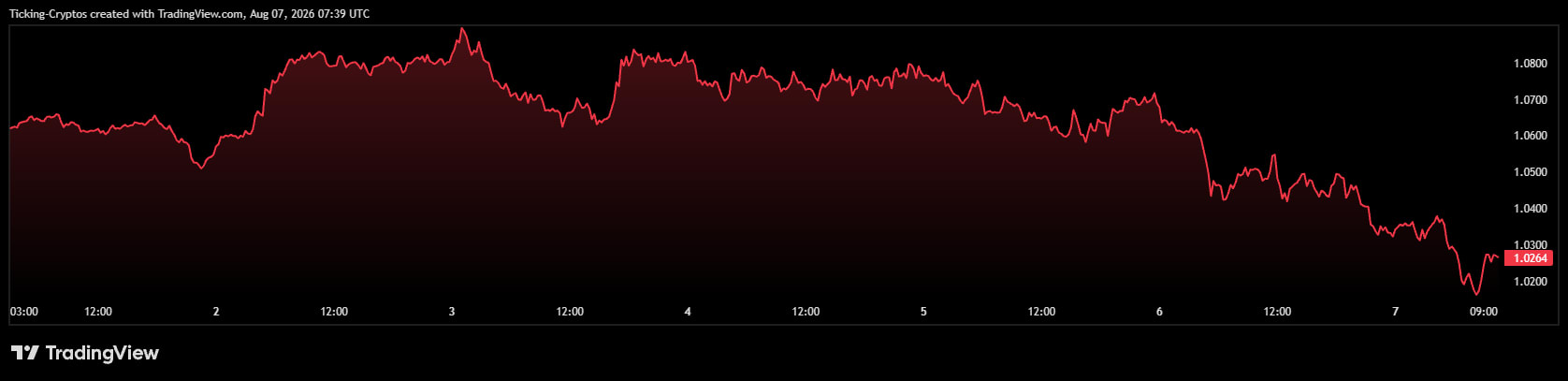
The assets carrying a “passage premium” are the ones exposed. XRP sits first in line, because the bill would settle its classification question. XRP is down 4.59% on the week, the worst performer among the majors, and it is sitting on $1.02. That is not a coincidence.
For everything else, the delay reinforces the status quo: regulation by SEC and CFTC guidance rather than by statute. That ambiguity justifies a risk premium for institutional allocators and slows product and custody planning at firms that have been waiting for a rulebook. It does not change what Bitcoin is.
📖 Our full XRP analysis: is it a buy at these levels?
2. 💥 A $45 Billion AI Fund Vaporised in Weeks. Crypto Shrugged.
If you want a reminder that leverage is the only thing that ever really kills anyone, this was the week.
Leopold Aschenbrenner is 25. He left OpenAI in 2024, published a 165-page essay called Situational Awareness that became required reading across Silicon Valley, and turned it into a hedge fund of the same name. The thesis was clean: more capable AI means enormous demand for chips, memory, data centres and power. Long the picks and shovels, short the software companies AI would disrupt.
It worked spectacularly. The Financial Times reported gains of 1,551% since launch, with the fund up 439% in the first half of 2026 alone. Assets peaked around $45 billion at the start of July.
Then it went the other way. A momentum reversal hit both sides of the book at once. The AI infrastructure longs (Nebius, Sandisk, Micron, CoreWeave, SK Hynix, Bloom Energy, IREN) fell hard, several by more than 35%. The software shorts, including names like Adobe, went up. With reported leverage as high as 4x, the margin calls arrived fast.
Prime brokers Bank of America, Goldman Sachs and JPMorgan worked with the fund on requirements before the endgame. On 30 July, Situational Awareness sold its entire public book to Ken Griffin’s Citadel at a discount. Assets fell to roughly $10 billion. The investor letter reported a 67% portfolio decline for July.
Why this belongs in a crypto newsletter:
Bitcoin barely reacted. The correlation everyone assumes between crypto and the AI trade did not show up when it mattered. BTC spent the entire episode inside the same range it has occupied for weeks.
It is the cleanest available proof that the AI trade is a leverage story, not just a narrative story. The underlying thesis may still be correct. The financing structure was the failure point.
The FTX thread is uncomfortable. Aschenbrenner’s early work experience included FTX, where he helped run the firm’s charity arm. Critics had flagged his lack of money management experience before launch. As one Wall Street voice put it, plenty of people saw this as a matter of when, not if.
The broader read for crypto holders is simple. When a large levered book is forced to liquidate, correlations go to one for a few hours and then decouple again. Positioning for that is a risk management question, not a directional one.
📖 Read the full breakdown, including the FTX connection
3. 🔓 Coldcard: The Number Kept Climbing All Week
We covered this last issue. It is here again because the tally did not stop.
The sweeps that began on 30 July ran in four waves through 3 August. Galaxy Research now puts the running total near 1,816 BTC, close to $116 million, taken from more than 5,200 addresses. The first wave alone moved roughly 594 BTC out of around 500 wallets in 25 minutes.
The cause remains a single unchecked condition in firmware shipped in March 2021. A build setting told the device to skip its dedicated hardware random number generator. A supporting library checked whether that setting existed, but never whether it was switched on. Seed generation fell through to a deterministic software generator seeded from the chip serial number and timer state. Block’s Bitcoin Engineering and Security team, which disclosed the finding to Coinkite on 30 July, put the effect plainly: effective key strength collapsed from a designed 128 bits to as little as 40 bits on older devices.
The one thing worth repeating, because people are still getting it wrong: updating the firmware does not repair a seed that was already generated weakly. If you created a seed on a Coldcard between March 2021 and the patch, treat it as compromised. New seed, new addresses, funds migrated. Mk2, Mk3, Mk4, Mk5 and Q may all be affected depending on which firmware was running at the moment of seed creation.
Coinkite has published its advisory and is assisting victims. It has not offered compensation.
The reflex after a story like this is to pause self-custody and leave everything on an exchange. That is the wrong lesson. Cold storage still removes counterparty risk, which is what has destroyed the most crypto wealth over the last decade. What changed is the maintenance assumption.
🔎 Not Sure Which Wallet or Exchange Actually Holds Up?
We rebuilt both comparisons this week off the back of the Coldcard case and the ESMA register.
Hardware wallets: which vendor has which track record, what each one got wrong before, and how to build a setup that survives a single-vendor failure.
👉 Read the hardware wallet comparisonExchanges: our crypto exchange comparison lists the legal entity and authorisation date for every MiCA-licensed venue, each one checked against the register itself.
👉 Compare exchanges here
4. 🚀 SpaceX Beat on Everything That Matters, and Fell Anyway
SPCX reported its first quarterly results as a public company after the close on 4 August. The numbers were strong.
Revenue: $7.81 billion, up 92% year on year, against roughly $6.93 billion expected
Loss per share: $0.09 versus $0.26 expected
Net loss: narrowed to $541 million from about $1 billion
Adjusted EBITDA: roughly $3.54 billion, up around 191%
Connectivity: $4.3 billion in revenue and 1.7 million net subscriber adds
AI segment: revenue up 247% year on year to $2.6 billion
Management guided to a $100 billion annualised revenue run rate by the end of 2026 and pulled its internal $1 trillion revenue target forward to 2030 from 2031.
The stock closed up 9.43% at $125.33 on the day of the report, then dropped roughly 8% after hours.
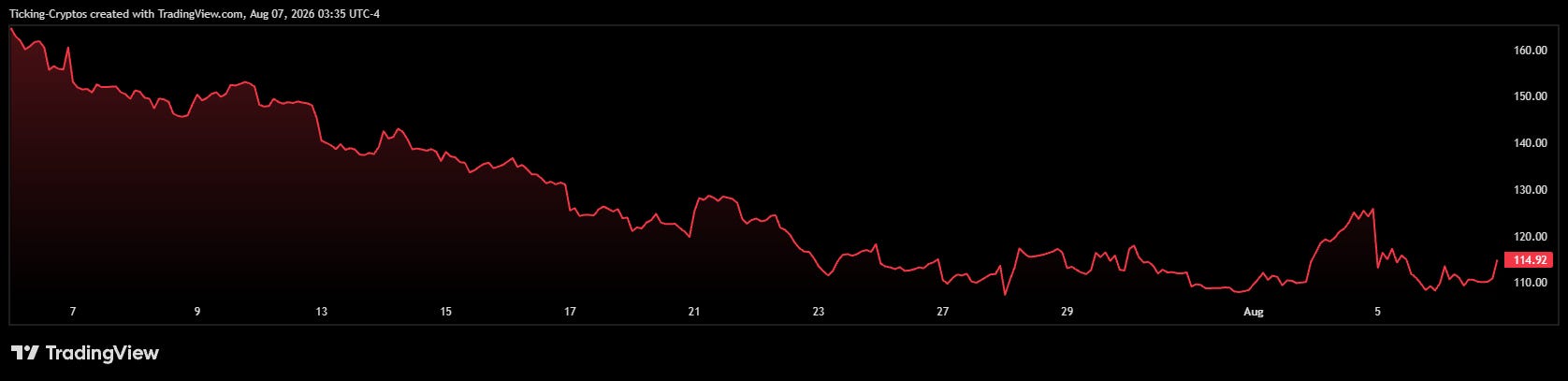
The number the market actually cared about was capital expenditure. Capex came in at $18.37 billion for a single quarter, against a $13.22 billion consensus estimate, with $15.83 billion of that going into AI. That is nearly as much as SpaceX spent in all of 2025, and management signalled the next two quarters could look similar. Cash and equivalents stand at $93.5 billion after the record IPO. Debt and finance leases have climbed to $36.8 billion from $22 billion three months earlier.
📖 Read the five-phase SPCX chart breakdown
Then came the second problem. The first lockup expiry landed on 6 August, releasing roughly $123 billion in shares into the market. SPCX is already down around 44% from its $225.64 post-IPO peak in mid-June and trades below its $135 offer price.
The setup is a clean case study in supply versus fundamentals. The business is visibly improving. The float just got much larger. Those two facts do not resolve on the same timeline.
💡 If you want exposure to real SPCX shares rather than a derivative, XTB lists actual equities and ETFs alongside its CFD products. Worth comparing the instrument type before you buy.
👉 Check XTB
5. 🇪🇺 We Read All 329 MiCA Authorisations. Only 21 Are Exchanges.
ESMA publishes the MiCA register as an open file. Almost nobody reads it. We downloaded the version dated 4 August and worked through every line.
The headline: 329 authorisations, 72 of them in Germany, and only 21 that actually permit operating a trading platform.
That gap matters, because the phrase “MiCA licensed crypto exchange” is doing a lot of unearned work in marketing copy right now. A Latvian payment provider with a single national authorisation and a pan-European trading venue occupy the same register and can both truthfully claim MiCA authorisation. They are not the same product.
Two more findings worth carrying around:
MiCA protection attaches to a legal entity, not a brand. The authorised entity is almost never named after the app on your phone. Kraken appears in the register as Payward Global Solutions, for example. If you cannot map the app to the entity, you cannot verify the licence.
The register works in both directions. ESMA also maintains a non-compliant entities register, now at 167 entries after Italy’s CONSOB flagged three more firms in the latest update.
Meanwhile the EU exit wave continues. AscendEX ceased operations on 1 July with withdrawals available only on a limited basis. BitMEX is giving up its EU business. BitMart stops trading on 26 August 2026 and shuts entirely on 31 January 2027. If you still hold balances on any of these, move them rather than waiting for an extension that is not coming.
📖 Read the full register analysis
6. 📊 Price Check: The Top 7
Live snapshot, 7 August 2026:
Bitcoin ($BTC): $64,308.71 | 24h -0.73% | $1.29T cap
Ethereum ($ETH): $1,904.97 | 24h -0.30% | $229.89B cap
$BNB: $586.74 | 24h -1.34% | $78.13B cap
$XRP: $1.02 | 24h -2.26% | $64.16B cap
Solana ($SOL): $72.85 | 24h -1.47% | $42.4B cap
TRON ($TRX): $0.3266 | 7d -0.50% | $30.99B cap
Hyperliquid ($HYPE): $55.67 | 7d +0.54% | $14.07B cap
What Is Actually Happening in These Numbers?
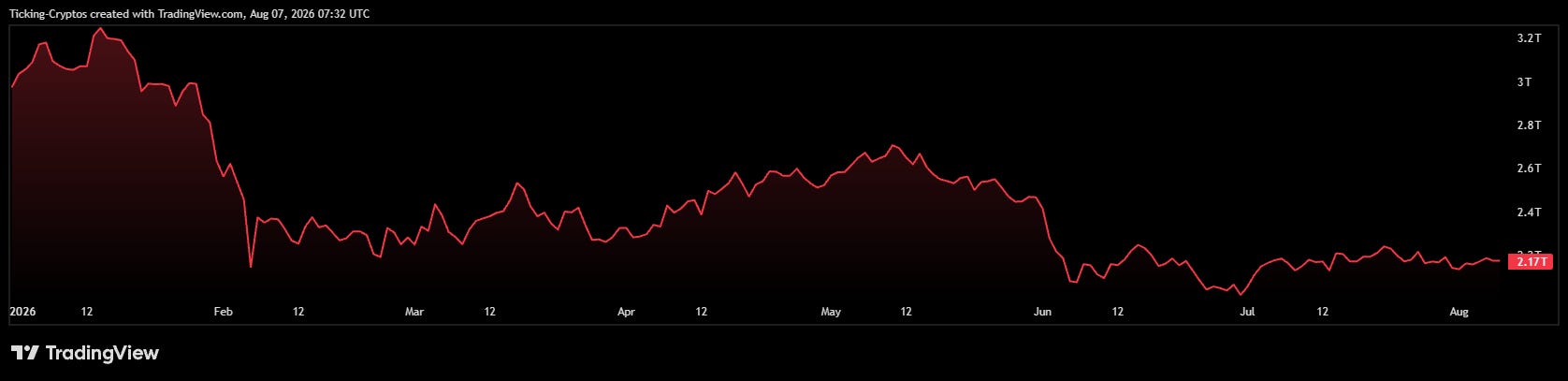
Bitcoin is compressing, not trending. A 0.37% weekly move with a 0.73% daily move underneath it is a market with no directional conviction. BTC has held above $64,000 after buyers defended $62,500 last week. Overhead supply sits in the $66,800 to $67,000 zone, where July’s advance was rejected. Neither side has the volume to break it. Total market cap sits around $2.28 trillion with BTC dominance at 56.7% and the Fear and Greed Index at 29, which is fear but improving from 25.
XRP wears the CLARITY delay. Down 4.59% on the week, the weakest of the majors, sitting at $1.02 with a 44.23% YTD loss. This is the passage premium leaking out in real time. Nothing on the Senate calendar puts it back before mid-September.
The YTD column is the real story. Bitcoin is down 26.5% on the year while Ethereum is down 35.8%, XRP down 44.2% and Solana down 41.5%. This is not a rotation. It is a broad drawdown in which the majors have fallen harder than Bitcoin, which is exactly what you expect when liquidity leaves rather than rotates.
Only two names in this group are green on the year: Hyperliquid at +118.93% and TRON at +14.92%. Everything else is carrying a double-digit annual loss. Hyperliquid is now the clearest example of capital concentrating into a single working product rather than spreading across the sector.
Nobody is moving. Six of these seven traded inside a 1.5% band over 24 hours. That is not calm, it is a market waiting on the jobs print and refusing to commit ahead of it.
7. 📰 This Week on CryptoTicker
Everything we published, in one place:
MiCA register analysed: only 21 of 329 authorisations are trading platforms
ESMA publishes the register of MiCA-authorised providers as an open file. We worked through all of it, and the result is not what the phrase “licensed crypto exchange” suggests.$130 Million Gone Because the Randomness Was Predictable: Which Hardware Wallet You Can Still Buy
The Coldcard flaw proved the most respected wallet is not the safest. Which vendor has which track record, and why now is the wrong moment to pause your savings plan.SpaceX Stock Update: SPCX Is Down 44% From Its IPO Week Peak, and Tonight Is the First Real Test
SPCX trades 44% below its IPO week peak and 12% under the $135 offer price. The chart splits into five clear phases, and earnings land after the close.Is XRP Coin a Good Buy At Current Prices?
XRP coin sits near $1.06 with the 200 EMA far overhead and the CLARITY Act stalled in the Senate. Here is what the daily chart says about buying now.Leopold Aschenbrenner: How a $45 Billion AI Fund Collapsed in Days, and What It Means for Crypto
A 25-year-old ex-OpenAI researcher lost most of a $45bn fund in a week on 4x leverage. The mechanics, the FTX thread, and why Bitcoin shrugged.
8. 🗓️ The Week Ahead: Three Dates That Decide August
Today, 7 August: US July jobs report, 8:30am ET. Economists expect around 85,000 new jobs and unemployment holding at 4.2%. June came in at just 57,000, the weakest in four months. This is the first major data point since the Fed’s 29 July decision to hold at 3.50% to 3.75%, and that decision matters more than usual: the 9-3 vote was the most divided since 2016, with regional Fed presidents Hammack, Kashkari and Logan all dissenting in favour of a hike, not a cut. A soft print supports the hold. A hot print with accelerating wage growth makes the dissenters harder to ignore, which is a genuine risk for high-multiple tech and, by extension, for crypto beta.
Also today: weekly BTC and ETH options and futures expire on Deribit and CME, landing on the same day as the jobs data. Expect noise.
12 August: July CPI. 13 August: July PPI. These are the two inflation reports markets will weigh most heavily ahead of the 15-16 September FOMC.
19 August: July FOMC minutes, detailing how the committee handled the three-way dissent.
14 September: the Senate returns, with roughly three weeks of working time and the CLARITY Act queued up first. That is the date to circle. After it, midterm season swallows the calendar.
One more thing to watch: Deribit’s most popular position is currently the $60,000 Bitcoin put, with over $1 billion in notional open interest. Traders are paying for downside protection into a month that has closed red every year since 2022, with a median August return of -7.87%. That is positioning, not prophecy, but it tells you where the fear sits.
9. 🧠 Weekly Trivia
Question: In early May, prediction markets gave the CLARITY Act better than a 70% chance of being signed into law in 2026. After this week’s delay, where do those odds sit?
.
.
.
👉 The answer: around 15%. Polymarket contracts on a 2026 signing collapsed from above 70% in early May to roughly 15% now, across more than $5 million in volume. Galaxy Research had already cut its own estimate from 50% to 30% before Thune’s confirmation landed. The bill is not dead, but the market has stopped pricing it as a 2026 event.
This newsletter is for informational purposes only and does not constitute investment advice or a recommendation to buy or sell any asset. Crypto assets are highly volatile and you can lose your entire invested capital. Always do your own research before making financial decisions.